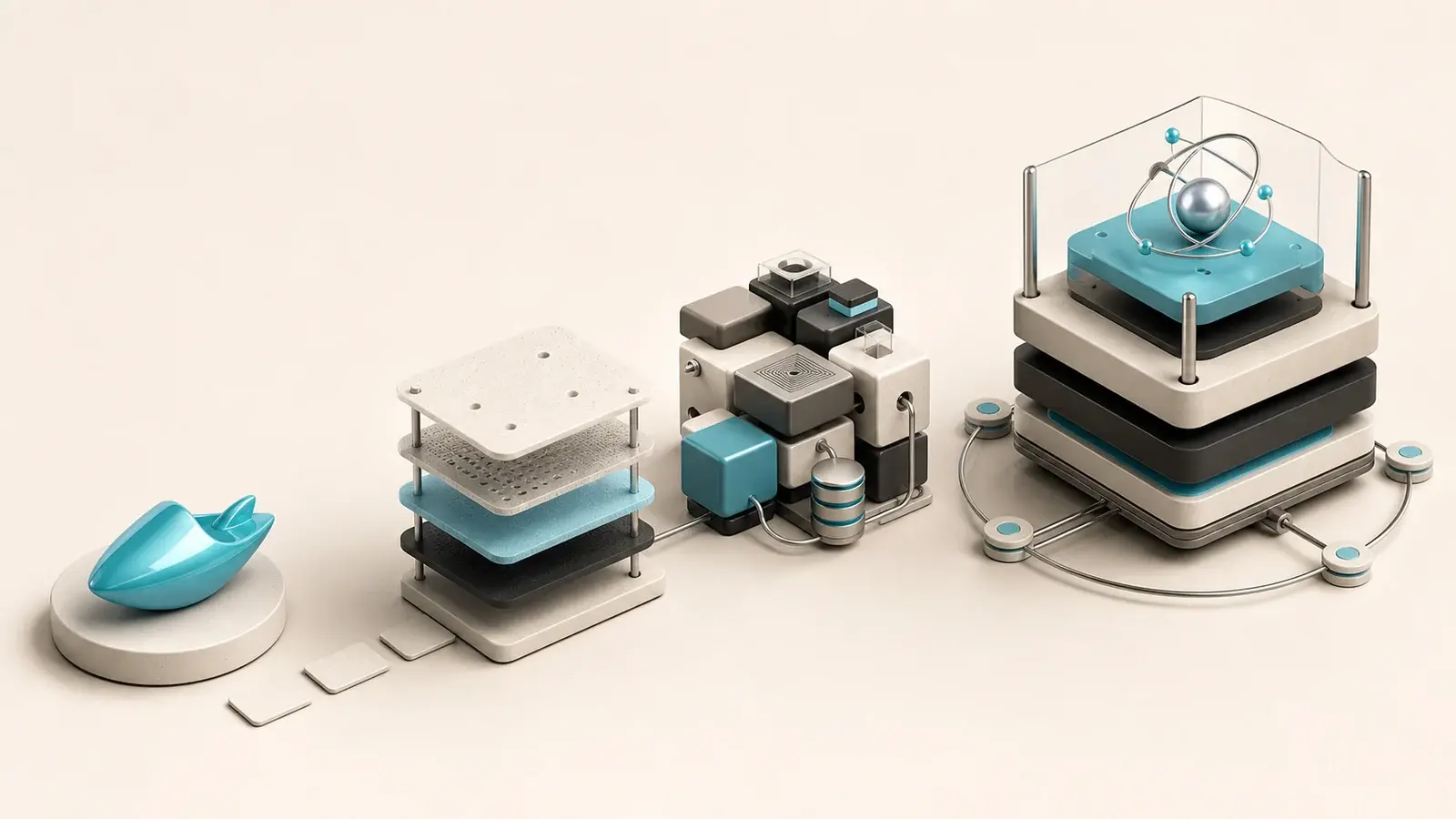
A prototype proves that an experience is possible. A product proves that it can be trusted repeatedly. Moving between the two requires a deliberate shift in architecture, ownership, controls, measurement, and support.
In this article
- The different jobs of prototypes and products
- What a convincing demo leaves unanswered
- Designing for reliability, security, and change
- Turning uncertain behavior into an observable system
- Creating ownership around the whole service
- A readiness gate for responsible launch
A prototype and a product answer different questions
A prototype asks whether an idea could create value. It compresses complexity to make learning fast: a narrow dataset, a controlled environment, a friendly user, a happy path, and manual work behind the scenes are all legitimate. The team is buying evidence about desirability and feasibility before committing heavily. Judged by that purpose, shortcuts are not defects; they are part of the method.
A product asks whether the organization can deliver that value consistently to real users under variable conditions. It must survive incomplete inputs, traffic changes, upstream failures, permission differences, staff turnover, and evolving requirements. It must also fit the economics and controls of the business. A brilliant demonstration can establish momentum, but it does not answer these questions because it was never designed to.
Trouble starts when enthusiasm collapses the distinction. Stakeholders see a polished interaction and assume the work is nearly complete. Engineering teams inherit hidden manual steps and placeholder decisions as implied requirements. A safer transition begins with an explicit reset: document what the prototype proved, what it deliberately ignored, and which assumptions now need production evidence.
The demo proves the value can appear. The product must prove the value can be delivered, governed, supported, and improved.
Make the prototype’s hidden conditions visible
Before planning a build, create an assumption ledger. Record who the target user is, which workflow is in scope, where data originates, what quality was assumed, which steps were manual, how edge cases were handled, and what external services were trusted. Mark each assumption as validated, uncertain, or contradicted. This prevents a common failure mode: treating a successful demonstration as evidence for conditions that were never tested.
Next, model the service around realistic demand and failure. What happens when a dependency times out? Can a user safely retry? Is an action idempotent, or could it create a duplicate order or message? How are partial results represented? Can administrators correct a bad state without database surgery? The answers influence architecture, experience design, and operating procedures, so they cannot be delegated to a late “hardening” phase.
Finally, define the value boundary. A product is not production-ready because every imagined feature exists; it is ready when a coherent outcome can be delivered within agreed constraints. Narrowing the first release to one well-supported workflow is often more responsible than exposing a broad experience with weak controls and ambiguous support.
- User and workflow assumptions
- Data sources, quality, permissions, and retention
- Manual interventions and exception handling
- External dependencies and failure behavior
- Expected demand, cost drivers, and support model
Engineer for trust, not only function
Production architecture should be driven by consequences. Identify the actions or data that could create financial loss, privacy exposure, operational interruption, or loss of customer trust. Apply stronger controls there: least-privilege access, explicit authorization, auditability, validation at trust boundaries, encryption where appropriate, and tested recovery. Avoid treating security as a single review at the end; threat decisions influence the shape of the system.
Reliability requires equally concrete choices. Set service objectives that reflect the user journey, not isolated component uptime. Design timeouts, retries, queues, fallbacks, and degradation around those objectives. Backups matter only if restoration is rehearsed. A rollback plan matters only if the team can execute it quickly. Where data changes state, define consistency expectations and reconciliation paths before an incident exposes the ambiguity.
Maintainability is part of trust. Clear interfaces, automated tests at valuable boundaries, migration discipline, documented decisions, and manageable deployment units allow the product to change without fear. The objective is not maximal technical sophistication. It is a system whose risks are understood and whose behavior can be changed by people other than its original builders.
Replace demo confidence with production evidence
A prototype is observed by its creators; a product must explain itself to the team operating it. Instrument the complete journey: request arrival, critical decisions, external calls, state changes, outcome, and user-visible failure. Logs, metrics, and traces should connect through stable identifiers so a support question can become an actionable diagnosis. Collect only what is necessary, and design telemetry with privacy and retention obligations in mind.
Measure product value alongside system health. Completion, time to outcome, correction rate, abandonment, and support demand may reveal that a technically healthy feature is failing users. Pair leading indicators, such as latency or queue depth, with outcome indicators, such as successful completion. Give each metric an owner and a response rule; a dashboard no one acts on is decoration.
Use progressive exposure to validate behavior. Internal use, a controlled cohort, limited workflows, and staged traffic allow the team to learn while limiting impact. Define expansion, pause, and rollback criteria before launch, when incentives are calmer. For features with consequential automated decisions, include human review or constrained authority until evidence supports broader autonomy.
Observability is the product’s ability to provide evidence about what happened, whom it affected, and what the team should do next.
Build the service around ownership
Production readiness is an organizational property. Name one accountable product owner for the end-to-end outcome, not only the interface. Establish engineering ownership for components and integrations, operational ownership for process changes, and clear escalation paths for incidents. If a customer-visible service crosses team boundaries, those teams need agreed service expectations and a way to resolve competing priorities.
Design support at the same time as the product. Decide where users seek help, what context support teams can access, which issues they may resolve, and when engineering becomes involved. Create runbooks for likely failures and administrative tools for safe correction. Feed recurring issues into product planning so support does not become a permanent manual patch around weak design.
Funding also needs to cross the demo boundary. A product requires capacity for maintenance, security updates, dependency changes, reliability work, and learning after launch. A business case that funds only initial delivery quietly assumes the service will stop changing at the moment real users begin teaching the team what it needs to become.
Use a readiness gate that tests the whole story
A useful readiness review is evidence-based and proportionate to risk. It asks whether a defined user group can complete a valuable journey; whether access and data handling are appropriate; whether critical failure modes have been exercised; whether the system can be monitored, supported, restored, and rolled back; and whether ownership and operating costs are accepted. Unresolved items should have explicit risk owners rather than being buried in a launch checklist.
Run a scenario rehearsal before wider release. Walk through a failed dependency, a bad data import, a permission mistake, a customer complaint, and an urgent rollback. Include product, engineering, operations, security, and support. Rehearsals expose missing authority and communication paths that static documents rarely reveal.
The transition from prototype to product is not a loss of speed. Done well, it converts fragile momentum into a platform for sustained learning. Teams move faster because they can see the system, change it safely, recover from failure, and trust the evidence. That is the real production milestone: not simply going live, but becoming capable of operating and improving the service once it does.
- Value: a complete journey works for a defined user group.
- Control: access, security, data use, and audit needs are addressed.
- Resilience: critical failures, recovery, and rollback have been exercised.
- Operations: monitoring, support, escalation, and ownership are active.
- Economics: ongoing cost and capacity are understood and accepted.
Have a consequential business problem worth solving?
Start a conversation